États des lieux
Larissa Fassler at the Musée d’Orsay
Musée d’Orsay
December 17th, 2025 - March 22nd, 2026
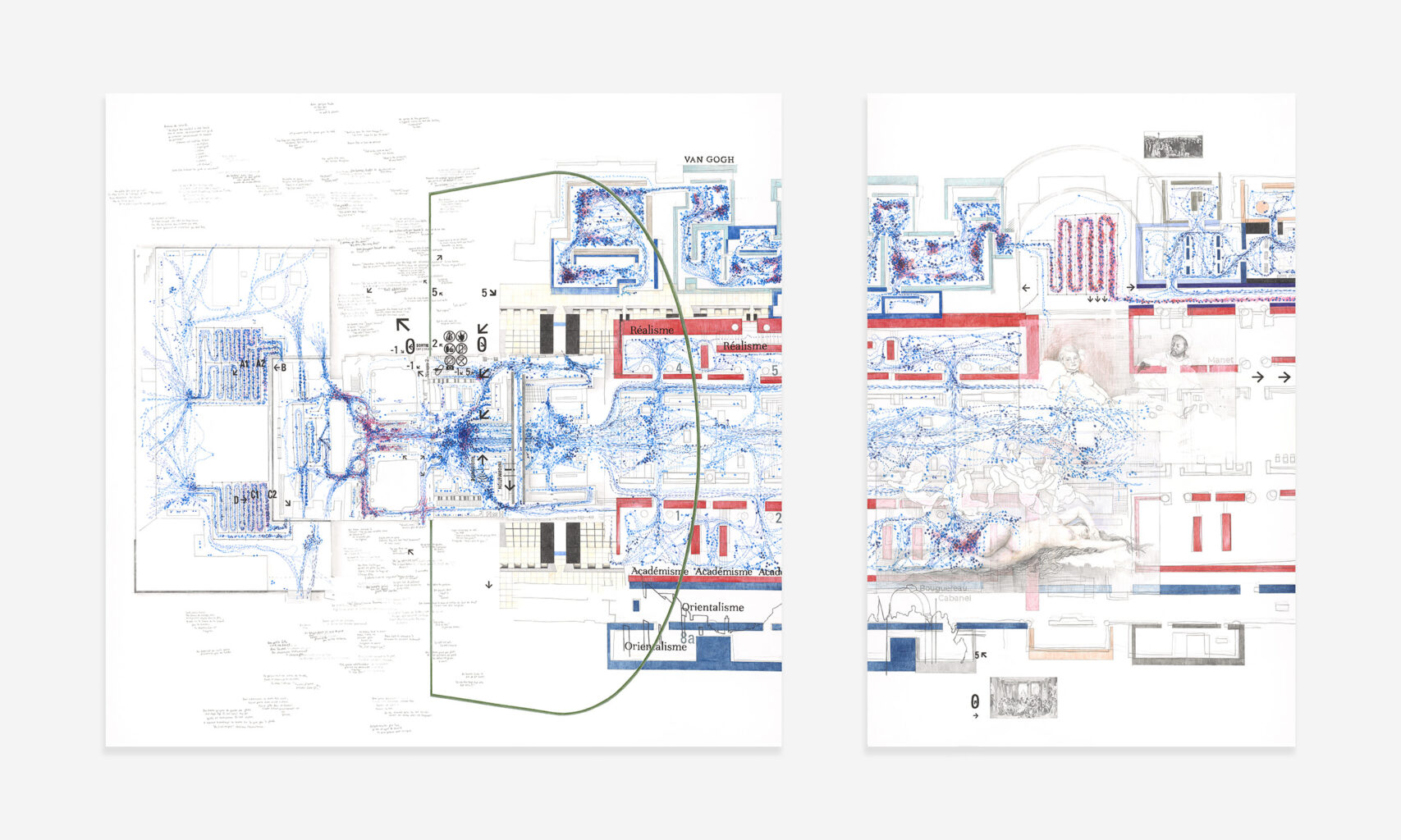

When the train station and Hôtel d’Orsay were transformed into a museum in 1986, the building was designed to welcome 1.5 million visitors per year. Today, more than four million people visit annually. To improve the visitor experience and accommodate this growing number, the museum has begun major renovation work. As this architectural transformation gets underway, the Musée d’Orsay invited artist Larissa Fassler to observe and respond to the process.
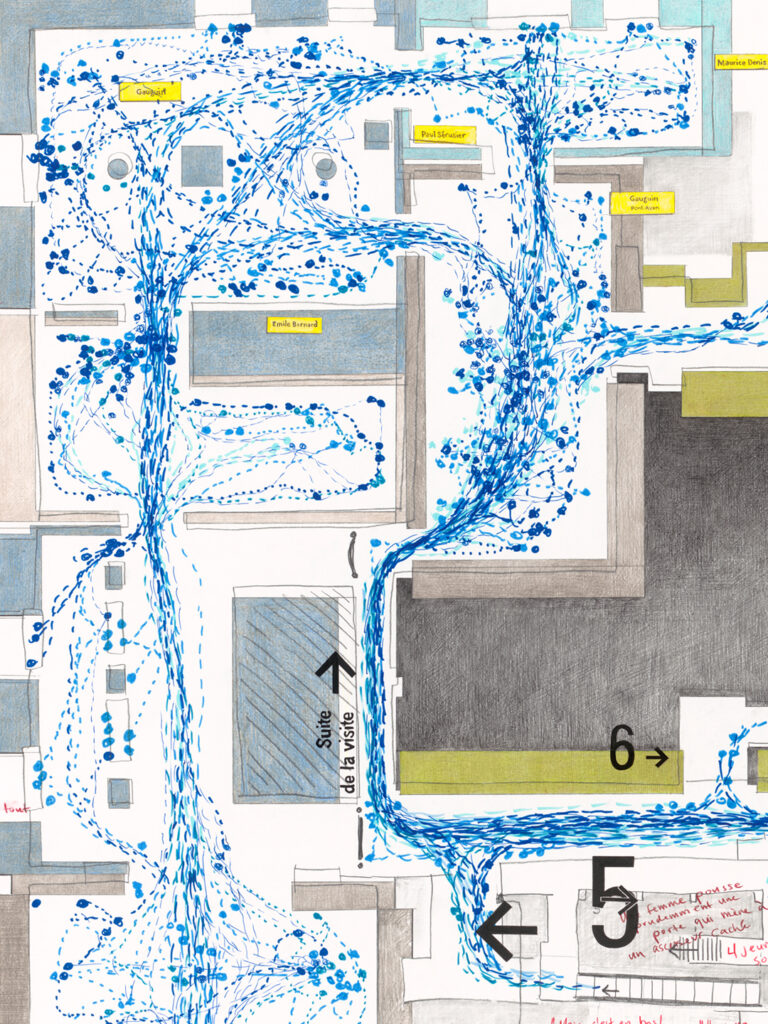
Fassler, whose practice centres on empirically mapping public space, spent three months in 2023 conducting on-site research at the museum. For this period, the Musée d’Orsay became both her studio and her subject. She visited daily and used her own body as a tool to measure and map its architecture, walking the perimeters of the entrance, the nave, the galleries, the stairwells, passageways, and lifts. Each space became a hand-drawn record of where people circulate, where bodies are directed, and where they are made to wait.
Across these drawings she charted the movement of visitors. A blue dot marks a pause. A broken line follows a path. When tension enters the room, the line turns red. When a body is blocked, frustrated, displaced, or pushed out of rhythm, it is recorded. Alongside this, she noted fragments of overheard conversation, gestures, clothing, discomfort, stillness, and the quiet authority of museum signage and arrows.
Underlying the work is the nineteenth century’s fixation on the female body, not only as subject but as surface, site, ornament, and spectacle. Fassler is attentive to the layered economies of looking: the collective gaze of the crowd, the authoritative gaze of the painter, the consuming gaze of the Instagrammer, and the often silenced gaze of the portrayed.
In the central nave, a quiet confrontation emerges. On one side, Académisme: idealised, mythologised, perfected, bodies arranged for pleasure in warm tones of compliance and erotic passivity. On the other, Réalisme: political, resistant, gritty, the palette cooling into sallow shadow.
A face does not look away. She meets our gaze. She refuses to disappear.
More information: Musée d’Orsay